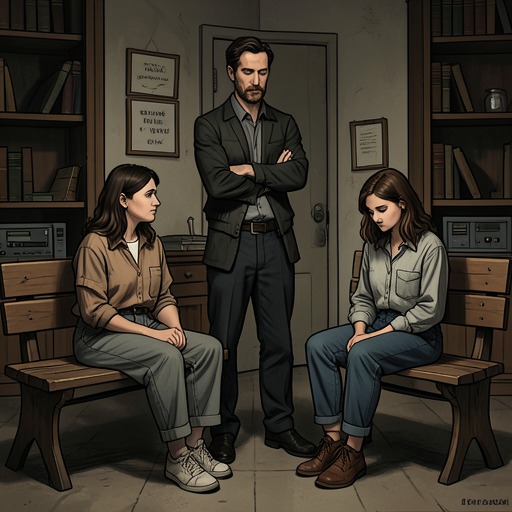
Simon Cancels the Basque Trip
And Their Children After ThemSimon Cancels the Basque Trip is the episode in which a planned vacation with Stéphanie and Clémence collapses after Simon reveals that he is leaving for California instead. The cancellation exposes the distance between the girls’ shared plans and Simon’s private decision: he has known for a week, has already packed, and is due to leave in three days. It also marks a sharp turn in Stéphanie’s response to him, from wanting his attention immediately to refusing even to drive him home.
The announcement and the lost plan
The news comes in the car, where Stéphanie has been watching Simon in the rearview mirror. He wears Quiksilver glasses and appears, to her, superior and indifferent as usual. That air of detachment is precisely what makes her want to matter to him; she has fallen silent, eager to be alone with him, and imagines herself willing to do whatever he wants. Into that charged quiet, Simon casually announces that Biarritz is not happening. The offhand delivery gives no warning of the change’s scale. Clémence turns around, and Stéphanie nearly stalls the car.
Simon explains that his older cousin Julien had been due to spend a month on the West Coast of the United States. The trip had been arranged long in advance, but Julien broke his leg roller skating. Simon has taken his place and will spend the month with a family of psychologists in Carmel, California. He presents the opportunity as too good to refuse and says he is sorry. The explanation makes the substitution understandable on its own terms, but it does not undo what the girls had arranged around him or soften the shock of learning that their shared vacation is over.
A week of silence
The injury and replacement explain why Simon is going; they do not explain why he waited to tell Stéphanie and Clémence. When asked how long he has known, he answers that it has been a week. The girls point out that their plans depended on him and ask why he did not warn them. Simon says he did not know how to tell them and repeats his apology. His account therefore contains both regret and concealment: the decision may have arrived through circumstance, but the silence that followed was his own.
That delay sharpens the imbalance already present in the car. Stéphanie has been measuring the moment by whether she can matter to Simon, while he has kept a consequential change to himself for a week. His manner remains casual enough that his explanation cannot restore the closeness she had been hoping for. The episode makes the cancelled journey more than a logistical disappointment: it reveals that the girls’ investment in the plan, and in Simon’s presence, has not been matched by his willingness to include them in his decision.
The ride ends
Stéphanie considers how long Simon would have to walk to town: at least an hour, with his suitcase, in the heat. The prospect pleases her. She orders him out of the car. Clémence is silently jubilant; Simon gets out with ill grace and starts toward the bus stop, looking back now and then in the hope that they will relent and offer him a ride home. Neither does. The prospect of helping him is set aside, and Stéphanie’s thoughts turn instead to his hands on her body. Remembering his touching changes the emotional charge of the scene: the attention she had wanted now registers as something she resents, and her refusal is directed at more than the inconvenience of his announcement.
Clémence calls Simon a loser, and Stéphanie agrees. The brief exchange gives their anger a shared expression, in contrast to the private, unequal expectations that had shaped Stéphanie’s attention to him earlier. Simon is left to walk; the girls remain together. Their solidarity does not repair the cancelled vacation, but it makes the departure final rather than tentative.
The last high-school vacation
Stéphanie gets back behind the wheel, releases the hand brake, and drives toward Heillange beneath a cement-like sky in the thick July heat. She drives fast, without caution or pleasure, and says nothing. The lack of conversation carries the disappointment forward: the trip has not simply been rescheduled, but lost. The narration identifies it as their last vacation as high-school students, giving the cancellation a particular finality. There will not be another summer in which the same plan can be recovered on the same terms.
The scene ends not with Simon’s Californian opportunity but with the sadness shared by Stéphanie and Clémence, rising in their tightened throats as they head home. Its decisive movement is from anticipation to disillusionment. Stéphanie begins the drive longing to matter to Simon; after his announcement, the week of silence, and the memory of his hands, she sends him away. The broken plan thus exposes both the fragility of the girls’ last shared holiday and the difference between the future Simon can seize for himself and the one they had imagined together.